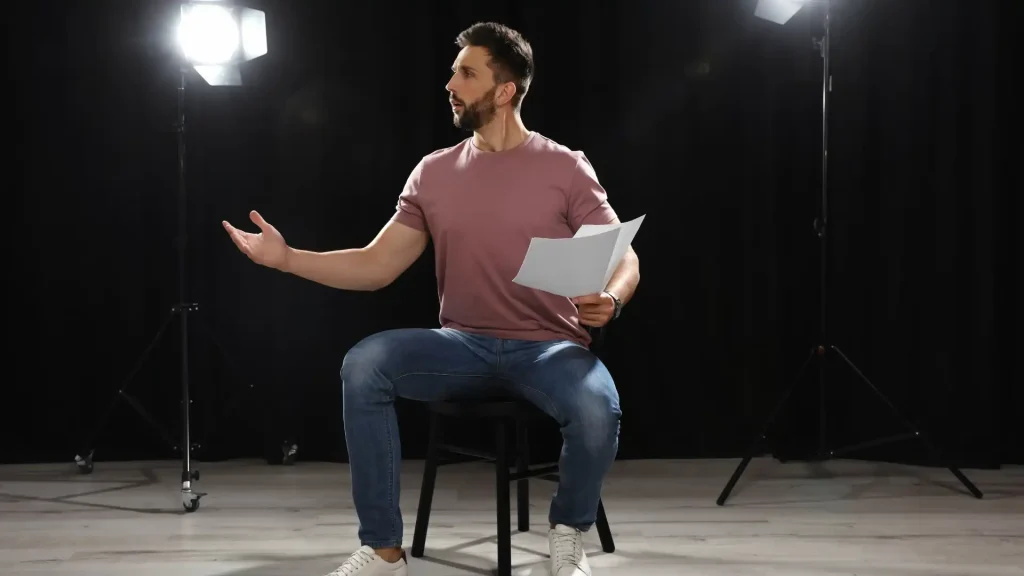
The phrase "stage confidence" is used in so many different ways that it has become almost meaningless. Sometimes it is offered as an explanation for why a performance works — "they have real stage confidence" — and sometimes as a diagnosis for why it does not. It is attributed to personality, to experience, to a kind of native talent, and occasionally to alcohol. What it rarely is, in ordinary conversation, is treated as what it actually is: a learnable skill that develops through specific kinds of practice.
This matters because the belief that stage confidence is a fixed trait — that you either have it or you do not — is one of the most limiting ideas a developing actor can carry. It turns a technical problem into an identity problem, and identity problems are much harder to work with.
What stage confidence actually is.
Stage confidence, in practical terms, is the ability to remain present and purposeful in front of an audience or a group of observers without being substantially derailed by self-consciousness. It does not mean the absence of nervousness. It does not mean performing without internal commentary or doubt. And it has nothing to do with extraversion, volume, or the ability to command attention in social situations.
Most professional actors experience something that, in any other context, would be called anxiety before performances. What distinguishes them from actors who are derailed by that feeling is not the absence of the feeling but their relationship to it. They have, through extended practice, developed the capacity to be nervous and present at the same time. The nervousness becomes information rather than obstruction.
This is not a mystical quality. It is the product of a specific kind of training — one that gradually expands what an actor can hold at once, and that shifts their attention from internal monitoring toward the external circumstances of the scene or the performance.
The role of exposure.
The most straightforward mechanism by which stage confidence develops is repeated exposure. This is well established in the psychology of anxiety: graduated exposure to feared situations, when approached consistently and without avoidance, reduces the intensity of the anxious response over time. The feared thing becomes familiar, and familiar things are less threatening.
For actors, this means that being watched repeatedly — in structured, low-stakes environments — is itself a form of technical training. Every session in which you perform a small exercise in front of other students, receive feedback, and survive the experience intact is adding to a store of evidence that being observed is manageable. Over time, this evidence becomes a stable foundation.
The important word here is structured. Unstructured exposure — putting yourself in front of an audience without adequate preparation, or performing before you have anything real to offer — can reinforce anxiety rather than reduce it. The experience confirms the fear rather than contradicting it. What works is exposure that is calibrated: demanding enough to produce a degree of discomfort, but not so demanding that performance collapses entirely.
The problem of self-monitoring.
A significant portion of what people describe as stage fright is more precisely described as over-monitoring. The actor's attention is directed inward — toward how they appear, whether they are doing the right thing, whether their voice sounds strange, whether the audience is engaged — at the expense of the outward attention that acting actually requires.
This inward pull is natural. Human beings are generally oriented toward self-monitoring in social situations, and performance is an unusually exposed version of a social situation. The problem is that acting requires the opposite: sustained attention to the other person in the scene, to the physical and vocal impulses that arise from genuine engagement with the situation, and to the objective needs of the character in the moment.
Technique helps because it gives the actor something specific to attend to that is external — an objective, a specific action, a partner. When the attention is genuinely occupied by the task of figuring out what the other character wants and responding to it, there is simply less cognitive space available for the internal commentary that generates self-consciousness.
This is one of the reasons that scene work is, in many respects, easier than solo monologue work. There is another person to respond to, and that other person's behaviour provides a constant stream of genuinely interesting material to engage with. Monologue work demands a more developed capacity to sustain imagined relationship — which is partly why it tends to expose self-consciousness more readily.
Preparation as a confidence tool.
Anxiety in performance is often — not always, but often — a form of under-preparation expressing itself through the body. When an actor does not know their material deeply, when they have not thought carefully about the given circumstances, when the objective is vague or untested, the body registers this uncertainty as threat. The result is tension, vigilance, and the characteristic scatter of attention that we recognise as stage fright.
Adequate preparation does not eliminate anxiety, but it changes its quality. The well-prepared actor's nervousness is closer to readiness — a mobilisation of resources in advance of a demanding task — than to the threatened helplessness of someone who is not sure they can get through what they have committed to.
This has practical implications. Preparation for performance is not simply memorisation. It includes understanding why the scene exists; what each character wants and why they want it; what has happened in the scene before the scene starts; and what physical and vocal choices are consistent with the character's situation. Actors who prepare at this level have more to fall back on when anxiety arises. They have a structure that holds.
The physical dimension.
Physical tension is both a symptom of anxiety and a cause of it. When the body is held — shoulders raised, chest braced, jaw clenched — the brain interprets the physical signals as evidence of threat, which increases the anxious response, which produces more tension. This feedback loop is one of the reasons that stage fright can feel self-sustaining.
Voice and movement work is, among other things, an intervention in this feedback loop. Students who develop a more conscious relationship with their physical habits — who can notice tension and have tools for releasing it, who understand how breath supports rather than constricts the voice — have an independent channel for managing performance anxiety that does not require them to think their way through it.
A student who has done sustained breath work knows what supported, open breathing feels like in the body. In a moment of anxiety, returning to that physical baseline is possible in a way that it is not for someone who has never studied it. This is not a trick or a quick fix. It is a physical competence, developed over time through practice.
What confidence feels like.
Students who have developed genuine stage confidence often report that it feels different from what they imagined it would. It is not the absence of self-awareness or the disappearance of internal experience. It is more like a shift in where the weight of attention rests. Self-awareness is present, but it is not running the show. Attention is primarily outward — toward the partner, the space, the audience — and the internal commentary, while present, has become quieter and less authoritative.
There is also a characteristic quality of time. Anxious performance often has a frantic, compressed quality — as if there is never quite enough time to do what needs to be done, and the whole enterprise is always on the verge of collapse. Confident performance feels slower, not because less is happening, but because the actor is fully in the present moment of it and not splitting their attention between now and the feared future.
A note on the pace of development.
Stage confidence typically develops slowly, and not always in a straight line. There are sessions that feel like breakthroughs, and sessions that feel like the old anxieties have returned, and sessions that feel entirely unremarkable. This is normal. Development in acting does not proceed like a graph with a consistent upward slope. It proceeds through accumulation — the slow building up of evidence, experience, and embodied knowledge that eventually reaches a tipping point and seems to change everything at once.
The most useful thing a student can do, in practical terms, is to keep showing up. To return to the studio after a bad session. To do the preparation even when it feels futile. To engage fully with exercises that feel awkward or pointless. The accumulation depends on consistency, and consistency is a form of discipline that produces its own kind of confidence — the quiet confidence of someone who does the work.
About this article
Written by Marcus Hale, Lead Acting Instructor at Drenovo. The observations in this article reflect experience gained through many years of teaching acting in structured training environments. They are offered as practical reflection, not clinical or medical guidance.